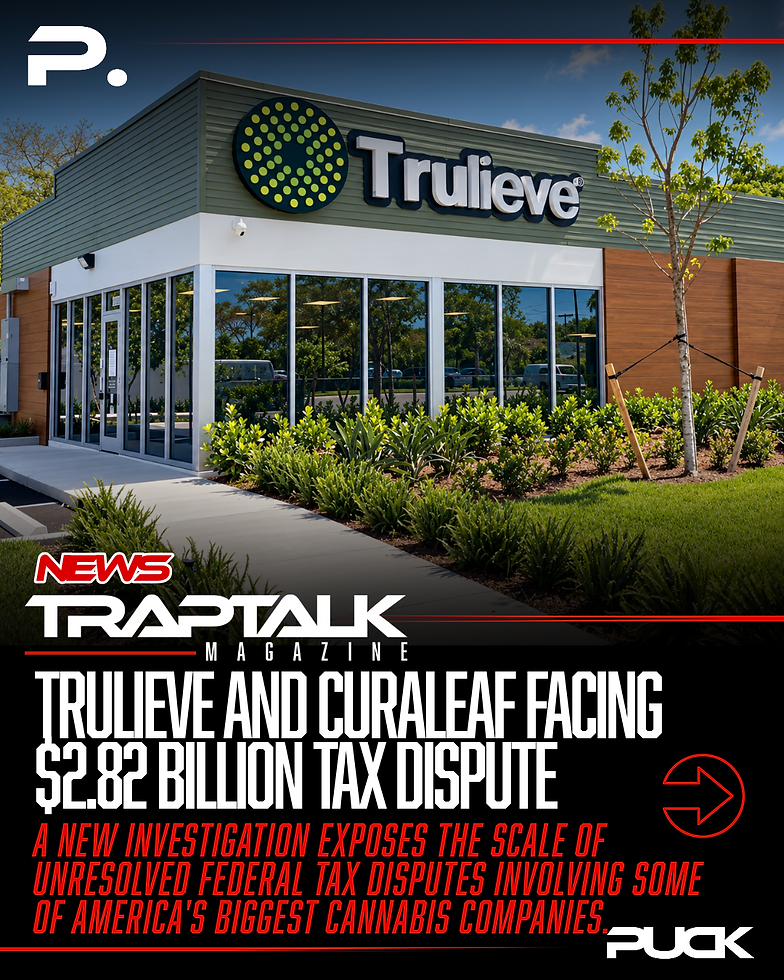
TRULIEVE AND CURALEAF AMONG CANNABIS GIANTS FACING $2.82 BILLION TAX DISPUTE

Fifteen major American cannabis corporations are carrying billions in disputed tax liabilities, as concerns continue growing over corporate expansion, major brand licensing agreements and who will ultimately control the industry's future.
Some of America's largest cannabis corporations are involved in significant disputes over their federal tax obligations, with a new investigation revealing approximately $2.82 billion USD in uncertain tax liabilities across 15 publicly traded companies.
Published by The Marijuana Herald on October 13, 2026, the investigation examined financial disclosures from major cannabis operators, identifying a combined $2.816 billion in disputed tax balances as of June 30. That represents an increase of approximately $47.3 million since the beginning of the year.
Among the companies carrying the largest balances are Trulieve and Curaleaf, two of the biggest names in corporate cannabis. Trulieve reported approximately $598.2 million in uncertain tax liabilities, while Curaleaf disclosed another $468.5 million. Together, the two companies account for more than $1.06 billion of the total.
Verano Holdings reported another $400.7 million, bringing the combined figure for those three operators to nearly $1.47 billion. Other companies included in the investigation were Green Thumb Industries, Cresco Labs, Jushi Holdings, TerrAscend, Planet 13 and several additional publicly traded operators.
The investigation found that 12 of the 15 companies recorded increases in their disputed tax balances during the first six months of 2026. Trulieve and Curaleaf were the only two reporting reductions, while Green Thumb Industries remained unchanged.
Much of the situation revolves around Section 280E of the US Internal Revenue Code, a federal tax provision introduced in 1982 that has historically prevented cannabis businesses from deducting ordinary operating expenses in the same way as conventional businesses.
For cannabis operators, this has meant restrictions on deductions for expenses such as wages, rent, advertising and other costs, even when operating legally under state cannabis laws. Although qualifying production and inventory costs are treated differently, Section 280E has remained a significant financial challenge throughout the regulated industry.
Several major cannabis corporations have challenged the application of these restrictions, arguing through their tax positions that Section 280E should not apply to their operations. Their financial statements acknowledge that these interpretations could ultimately be rejected by federal tax authorities.
Trulieve provides one of the clearest examples of how substantial these disputes have become.
Of its $598.2 million reported balance, approximately $583.1 million relates to the company's legal position challenging Section 280E. Its reported liabilities also include $87 million in accrued interest associated with uncertain tax positions.
In September 2025, the Internal Revenue Service proposed additional assessments against several Trulieve subsidiaries following examinations of their tax returns. The company has challenged those assessments through the IRS appeals process, including approximately $38.1 million in proposed penalties that sit outside its existing reported balance.
Curaleaf is facing its own substantial tax uncertainty, with the IRS examining federal returns covering 2020 through 2024. The company has also disclosed examinations involving state tax authorities, with its financial statements acknowledging the possibility of additional obligations if its legal interpretations are unsuccessful.
It's important to understand that the $2.82 billion figure does not represent money these companies have been definitively ordered to pay. These are reported accounting liabilities associated with disputed tax positions, and the eventual outcomes will depend on examinations, legal proceedings, settlements and regulatory developments.
Recent changes to federal cannabis classification have added another layer to the situation. In April 2026, qualifying state-licensed medical cannabis activities were moved into Schedule III, providing relief from Section 280E for qualifying activity going forward. However, historical disputes remain unresolved, while adult-use operations continue facing different federal restrictions.
While these financial issues are significant, there's another side to this story that deserves attention, particularly from the core cannabis culture.
Large corporate operators such as Trulieve and Curaleaf have become increasingly influential in shaping what the American cannabis industry looks like. Their involvement extends beyond cultivation and retail, with major licensing agreements, distribution networks and established brands becoming an increasingly important part of corporate expansion.
And for many people within the core culture, that growing corporate influence hasn't exactly been welcomed.
There's long been considerable resistance towards large corporations gaining control of an industry built by independent growers, breeders and legacy operators who established cannabis genetics and culture long before the legal market existed.
What makes the current situation particularly interesting is how many respected cannabis brands are now entering significant agreements with the same corporate operators that some within the culture have spent years criticising.
Trulieve provides a recent example. On September 28, 2026, the company announced an exclusive master licensing agreement with Connected, granting it rights to cultivate, manufacture and commercialise Alien Labs and Connected branded cannabis products in Florida and Texas.
The agreement covers genetics, trademarks and proprietary production knowledge, with opportunities to negotiate additional markets in the future. It also expands a relationship that has existed in Florida since 2022.
For Trulieve, agreements like these provide access to established brands and genetics with considerable recognition throughout cannabis culture. For the brands involved, they offer opportunities to enter markets that would otherwise require substantial infrastructure, licensing and investment.
But there's another question that comes with these arrangements.
As more respected brands enter licensing agreements with major corporate operators, how much control over the future of cannabis production, distribution and brand identity is gradually shifting towards a relatively small number of companies?
These partnerships aren't necessarily evidence that the brands involved have abandoned their standards, and the agreements themselves don't establish that product quality will decline. However, the concerns surrounding corporate production aren't difficult to understand.
Some of the biggest names in cannabis built their reputations around exceptional genetics and genuinely high-performance flower. Once those genetics are being produced across multiple facilities, sometimes by completely different cultivation teams, maintaining the performance and purity that established those reputations becomes an entirely different challenge.
Anyone familiar with high-performance flower knows that having access to exceptional genetics doesn't automatically mean the finished product will perform anywhere near its potential.
And when corporate operators increasingly control the production and distribution of established cannabis brands, questions surrounding consistency, quality and accountability become even more important.
There's also the bigger issue of where the industry is heading.
Corporate consolidation has been taking place for years, with major operators building extensive retail networks, acquiring businesses and securing licensing agreements with brands that already have strong cultural recognition.
For many within the traditional and high-performance scenes, the concern isn't simply that corporations are participating in cannabis. It's that the industry could eventually reach a point where a handful of major operators control much of the legal market, while the independent growers and breeders responsible for building the culture have increasingly limited opportunities to compete.
That outcome isn't guaranteed, but the continued concentration of retail access, cultivation capacity and brand licensing rights makes it a legitimate concern.
The contrast becomes even more noticeable when examining the financial positions of these corporations.
Companies such as Trulieve and Curaleaf have the resources to pursue complicated tax challenges, restructure their businesses and negotiate substantial licensing arrangements while maintaining large commercial operations.
Independent businesses generally don't have access to the same legal teams, capital or operating infrastructure.
And while many traditional growers continue dealing with wholesale pricing pressure, restricted market access and increasing operating costs, some of the industry's largest corporations are positioning themselves to benefit from future changes in federal tax treatment.
None of this changes the fact that Section 280E has created genuine financial difficulties for legal cannabis businesses of all sizes. However, it would be a mistake to examine these disputes solely through the challenges facing major corporations without considering the broader changes taking place throughout cannabis.
The investigation ultimately reveals just how much financial uncertainty remains behind some of the biggest names in American cannabis.
Whether the companies successfully challenge their historical tax liabilities, reach settlements or eventually face substantial payments remains to be seen.
But beyond the $2.82 billion in disputed liabilities, there's a much bigger conversation developing around corporate influence, the increasing number of respected brands entering major licensing agreements and what that could eventually mean for independent cannabis businesses.
The legal cannabis industry is continuing to expand, and major corporations are becoming increasingly influential in deciding how products reach consumers.
For the core culture, the concern is whether the growers, breeders and independent brands responsible for establishing much of what makes cannabis valuable will retain meaningful control as that expansion continues.
Because the question isn't just how much money these corporations might eventually owe.
It's how much of the cannabis industry they'll eventually control.
Article by WT Bridger


Comments